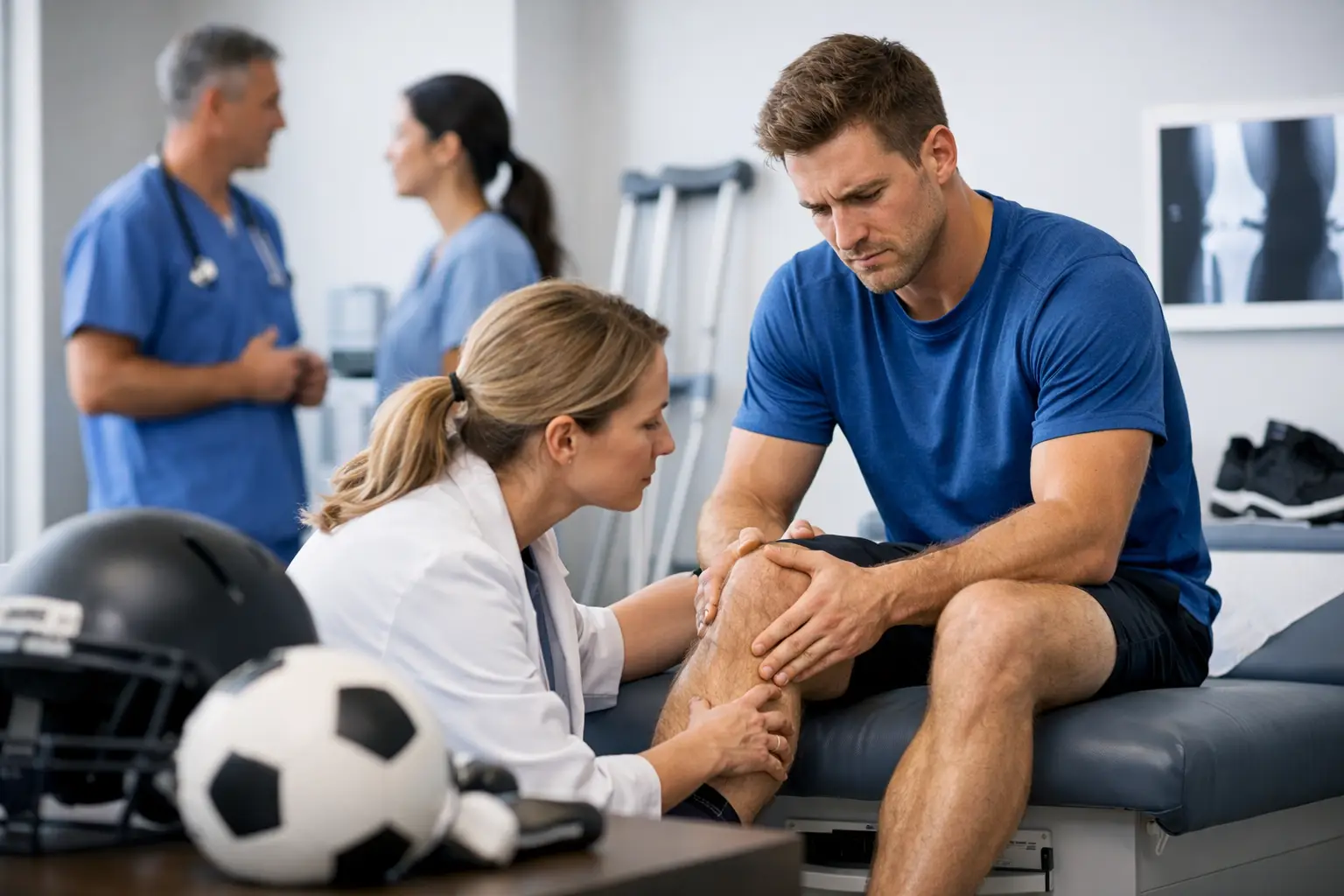
A rolled ankle in the second half, a wrist injury at practice, a knee that suddenly will not bear weight – these are the moments when sports injury urgent care becomes the practical next step. When the injury feels urgent but not life-threatening, waiting days for a regular appointment usually is not realistic. You want an exam and a clear plan. Treatment should help you decide whether to rest, brace, get imaging, or stop activity altogether.
For active adults, student athletes, and parents trying to make the right call fast, urgent care fills the gap between doing nothing and heading straight to the emergency room. The key is knowing what urgent care can handle and what needs emergency treatment. You should also know what to expect once you walk in.
What sports injury urgent care is best for
Urgent care is built for same-day problems that need prompt medical attention but are not immediately dangerous. That makes it a strong fit for many common sports injuries. This is especially true when pain, swelling, reduced motion, or concern about a fracture gets in the way of normal activity.
A sports injury urgent care visit often makes sense for sprains, strains, jammed fingers, minor joint injuries, muscle pulls, tendon irritation, mild concussions without red-flag symptoms, and possible simple fractures. It is also useful for cuts that may need cleaning or closure and bruising that seems worse than expected. Overuse injuries that have gone from manageable to limiting are another reason to go.
What urgent care adds is speed and decision-making. The goal is not just to tell you to ice it and take it easy. A clinician can examine the injured area, check for instability, assess range of motion, look for signs of a break, and guide next steps based on how the injury happened and what symptoms showed up right away.
When urgent care is the right call
The best time to use urgent care is when the injury needs attention today, but the person is stable. If someone twisted an ankle during a weekend game and now cannot walk normally, that is urgent. Another example is if a child collided with another player and has hand pain with swelling, that deserves prompt evaluation.
Urgent care is also useful when your primary care office cannot see you quickly, which is common with sports injuries that happen after school, after work, or on weekends. For many families, the value is simple – walk in, get assessed, and leave with a treatment plan while the injury is still fresh.
That said, not every sports injury belongs in urgent care. There is a real difference between painful and dangerous.
When to skip sports injury urgent care and go to the ER
Some injuries need emergency care right away. If there is heavy bleeding that will not stop, a visibly deformed limb, bone coming through the skin, loss of consciousness, severe head injury symptoms, chest pain, trouble breathing, or signs of a neck or back injury, the emergency room is the safer choice.
The same is true for numbness that does not improve, a cold or blue extremity, sudden severe swelling with intense pain, or confusion after a hit to the head. These are not watch-and-wait situations.
Concussion symptoms can be tricky because they exist on a spectrum. Mild symptoms may be appropriate for urgent care, but repeated vomiting, worsening headache, seizure, unusual drowsiness, slurred speech, or unequal pupils should be treated as an emergency. When the question is whether something is life-threatening or limb-threatening, err on the side of emergency care.
What happens during a visit
Most sports injury visits start with the story of how the injury occurred. That matters more than many people realize. A non-contact knee twist suggests different concerns than a direct blow to the knee. Landing awkwardly on an outstretched hand points the exam in one direction. Pain that built up over three weeks of training points it in another direction.
After that, the clinician will check pain level, swelling, bruising, joint stability, strength, sensation, and range of motion. They may compare one side to the other. In some cases, an X-ray is needed to rule out a fracture or check alignment. In others, the exam may suggest a soft tissue injury that needs support or rest. Follow-up may be recommended rather than immediate advanced imaging.
This is where urgent care is especially helpful. Not every injury needs an MRI on day one. Many need a careful exam, short-term protection, and a plan to watch how symptoms change over the next several days. If the injury looks more serious, you can be directed to the right follow-up care without losing time.
Common injuries urgent care can evaluate
Ankle sprains are one of the most common reasons people seek same-day care. Some are mild and improve with rest and compression. Others involve enough swelling and tenderness that a fracture has to be considered. A proper exam helps separate the two.
Wrist and hand injuries are another big category, especially in kids and teens. What looks like a simple jammed finger can sometimes be a fracture. Wrist pain after a fall should not be brushed off just because someone can still move it.
Knee injuries vary widely. A minor twist may respond to bracing and reduced activity, while locking, buckling, or significant swelling can point to a more involved problem. Shoulder injuries also range from muscle strain to dislocation or rotator cuff irritation. The early question is not always the final diagnosis. It is whether the joint is stable, whether movement is safe, and whether more imaging or specialist follow-up is needed.
Cuts, abrasions, and turf burns also deserve attention when they are deep, contaminated, or still bleeding. Infection prevention matters just as much as pain control. This is especially true when an athlete wants to get back to practice quickly.
What to do before you come in
A few basic steps can help before a sports injury visit. Rest the injured area. Use ice in short intervals. Compression can help with swelling if it does not increase pain. Elevation is often useful for ankle, foot, and knee injuries. Avoid trying to test the injury repeatedly just to see if it is getting better. That can make things worse.
If the person cannot bear weight, use support getting into the clinic. If there was a head injury, pay attention to changes in behavior, balance, headache, nausea, and alertness while you are deciding where to go. Bring any details you have about the mechanism of injury. This is especially important for school and youth sports injuries where the person evaluating it may not have seen it happen.
The trade-off between speed and specialization
Urgent care is not the final stop for every sports injury, and that is okay. Its role is immediate assessment and early treatment. For straightforward injuries, that may be all you need. For more complex injuries, urgent care helps you move faster by ruling out emergencies, starting treatment, and identifying when orthopedic or sports medicine follow-up is needed.
That trade-off matters. If you go straight to a specialist for every sprain, you may wait longer than necessary. If you ignore a serious injury because it seems minor at first, you can lose time that affects recovery. Urgent care works best as the middle ground – fast and practical.
For families in the Tri-Cities, that same-day access can make a big difference after school, on weekends, or when an injury interrupts work and daily routines. Health First Urgent Care sees the kinds of injuries that do not belong on a long wait list. They do not always belong in the ER either.
Returning to sports too soon
One of the most common mistakes after an injury is going back too early because the pain feels “not that bad.” Pain alone is not the best test. Swelling, weakness, instability, and limited range of motion can still put an athlete at risk even when the worst discomfort has faded.
That matters for adults as much as kids. Weekend athletes often push through injuries because they do not want to miss work or training. Parents may assume a child is ready because they are eager to play again. A rushed return can turn a short-term sprain into a longer recovery.
The best approach is to get the injury checked, follow the treatment plan, and pay attention to function, not just pain. If walking, gripping, cutting, jumping, or lifting still feels off, the injury is probably not ready for full activity.
A good rule: if the injury changes how you move, use it, or trust it, get evaluated. Fast care does not just help with comfort. It helps you make a smarter next move when sitting out for a day is frustrating, but playing through it could cost you a season.