
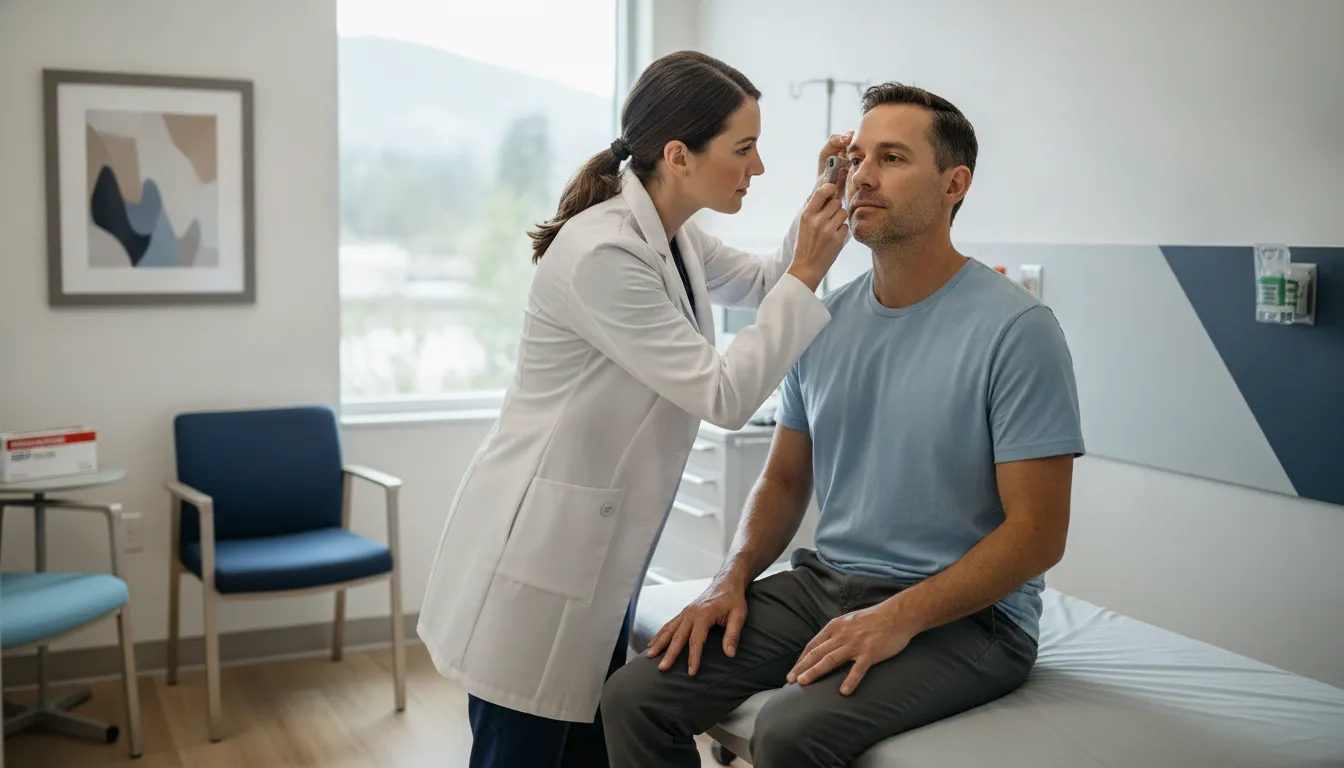
An eye injury can be frightening, and the bill can be hard to picture before anyone has examined the eye. Urgent care eye injury cost is not one published price. It depends on the clinician’s evaluation and on any supplies, imaging, or tests that exam shows are needed. A scratch, a chemical splash, and an object in the eye are not the same visit, so they should not be expected to produce the same charges.
Health First Urgent Care provides walk-in care for nonemergency injuries at clinics in Richland, Pasco, and Kennewick. Walk-ins are welcome subject to availability. A listing of injury services does not mean every eye injury can be fully managed at urgent care, or that every add-on service will be used.
For a nonemergency eye concern, call Health First Urgent Care at (509) 300-1500 or choose a clinic and request a visit.
If you have sudden vision loss, a chemical in the eye, an object stuck in the eye, severe pain, or bleeding you cannot control, call 911 or go to the nearest emergency department. Do not wait on a cost estimate for those symptoms.
What urgent care eye injury cost can include
People use “eye injury” for very different problems. One person has dust under a lid. Another was hit by a ball. A third splashed a cleaner and is unsure how much got in the eye. Those histories lead to different exams. The phrase alone cannot predict a bill.
A useful way to think about urgent care eye injury cost is as possible parts, not a package:
- The clinician’s evaluation and management of the injury.
- Supplies used during the visit, such as eye wash, a dressing, or other equipment.
- Imaging, if the clinician orders it and it is available.
- A lab test, if one is ordered. Some specimens may be sent to an outside lab such as LabCorp, which can bill separately.
- Any later balance after insurance processes the claim, or the self-pay amount if you are paying without insurance.
None of those lines is guaranteed. The clinician decides what the exam supports. You can ask how charges are organized without asking for a specific service to be performed. A price talk is not a treatment plan.
Health First’s injury services page says clinicians may evaluate minor cuts, sprains, strains, burns, sports injuries, work injuries, foreign bodies, and some fractures. Eye injuries are not a separate menu item with their own fee. Whether an eye injury is appropriate for urgent care depends on the injury and how severe it is.
Why two eye injuries can produce different bills
The same clinic can see two eye injuries in one afternoon and record different services. That is expected. The bill follows what was done, not the label the patient used when they arrived.
| Situation | What the visit may involve | What can change the bill |
|---|---|---|
| Mild irritation after dust or wind, with vision that feels normal | History and an eye exam. Irrigation only if the clinician decides it is needed. | Often closest to an evaluation. Extra supplies are not automatic. |
| Something that may still be on the eye surface | A careful look, and removal only if it is appropriate and can be done safely. | Supplies or a longer exam. Removal is not promised. See also foreign body removal cost. |
| A possible scratch after a fingernail, branch, or contact lens | An exam to judge the surface of the eye. A stain or other check only if the clinician orders it. | The exam itself, plus any supply or medication the clinician provides. |
| A blow to the eye or the area around it | An exam for vision, swelling, and whether a deeper injury is possible. | Imaging if it is ordered. Some blows belong in the emergency department instead. |
| A splash of chemical or other irritant | Urgent rinsing and an exam. Severe exposures need emergency care. | The visit may be short on paper and still urgent. Do not delay rinsing to compare prices. |
This table is a planning aid. It is not a menu, and it is not a quote. Health First does not publish a separate price for each of these situations. The clinician has to see the eye before anyone can say which lines will appear.
A red eye from irritation is also different from pink eye, which is a common name for conjunctivitis. If the problem is redness, discharge, or itching without an injury, the pink eye treatment cost guide is the closer match. This article stays with injuries.
How the $165 self-pay charge fits an eye injury visit
Health First publishes one self-pay figure patients can use as a starting point. For patients without insurance, or who are paying out of network, there is an out-of-pocket cost of $165 for a clinician visit to evaluate and manage symptoms. The pricing page says this amount already reflects a discount for payment at the time of service.
That $165 charge is not the urgent care eye injury cost by itself. The self-pay pricing page says it does not cover labs, X-rays, durable medical equipment, or other additional costs. An eye exam that stays at evaluation and management can be different from a visit that adds irrigation, a supply, or imaging.
Use $165 only as the published charge for that clinician visit when you are paying without insurance. Do not treat it as an all-in eye-injury price, a savings promise versus the emergency room, or the amount every patient pays. Insured patients should not assume $165 is their copay. Your plan, deductible, and coinsurance decide your share, and a balance can remain after the claim is processed.
Services are billed according to the fee schedule, with each service listed as a line item. Asking “what is included in the visit charge, and what is billed separately?” is more useful than asking for one eye-injury total before the exam.
What supplies, imaging, and outside labs can add
After the exam, the clinician may decide that rinsing the eye, a protective dressing, or another supply is appropriate. Those items are part of care only when they are used. They are not a standard add-on for every person who mentions an eye injury.
Imaging is similar. A blow near the eye sometimes raises a question about the bones around the eye. Health First has digital X-ray as a service category, but an X-ray is ordered only when the clinician believes it will help, and availability can vary by clinic and by what the visit needs. If imaging becomes its own question, the urgent care X-ray cost article covers how that line can be billed. This page will not repeat that price guide.
Lab testing is uncommon for a simple surface irritation, and it should not be assumed. If a test is ordered, ask where it will be processed. Some specimens are handled at the clinic. Some are sent out, including to LabCorp when an insurer requires it. An outside lab can send its own bill. There is no single turnaround time that applies to every test.
If the concern is a cut on the skin near the eye rather than the eye itself, cleaning and closure are a different conversation. Health First’s wound care cost guide explains how dressings and wound care can be itemized. A cut that involves the eyelid margin, or any cut with vision changes, needs the clinician’s judgment about the right setting. Do not decide that at home from a billing article.
How insurance and self-pay change your share
Health First accepts many insurance plans and files claims for in-network visits. Coverage still varies by plan and by service. The insurance page asks patients to check their own benefits before a visit. A copay collected at the desk is not always the full patient share. Coinsurance, a deductible, and a later balance can apply. An outside lab bill, if one is generated, may come from the lab rather than from the clinic.
Self-pay is the other common path. It applies when you have no insurance or you are using cash pay, including some out-of-network situations. In that case the published $165 figure is the clinician evaluation charge when it is paid at the time of service. Additional services remain extra. Comparing a self-pay visit with an insured visit only works when you compare the same services. An insured exam with imaging is not the same product as a self-pay exam with no add-ons.
Occupational injuries are a third path, and they are easy to mix up with a personal urgent-care visit. If the eye was hurt at work, the employer, the insurer, or the claims contact may need specific paperwork. Health First offers occupational health services, but a work injury is not automatically billed like a walk-in self-pay visit. Call the clinic and ask how a work-related eye injury should be checked in. Do not guess the authorization from a general pricing page.
One fee should stay out of this estimate entirely. The $50 no-show charge applies to scheduled occupational-medicine appointments that are missed. It is not an urgent-care walk-in fee, and it is not part of urgent care eye injury cost.
Questions to ask before you go
You will not get a guaranteed total before the clinician sees the eye. You can still make the conversation concrete. These questions keep the focus on billing parts rather than on a promised procedure:
- Is this concern something the clinic can evaluate today, or should I go to the emergency department?
- If I am paying without insurance, is the $165 charge the evaluation only?
- Which supplies, if any, are billed separately from that visit charge?
- Will any imaging be ordered, and is it available at this clinic today?
- If a test is sent out, who bills for it?
- If I am using insurance, what do you collect today, and can a balance still be billed later?
- If this happened at work, what should I bring so the visit is checked in correctly?
Write down the answers you receive, including which clinic you spoke with. Service availability is not identical at every site or every hour. A clear note is more reliable than trying to reconstruct the call from memory when the statement arrives.
When an eye injury should not wait for a price check
Cost questions are reasonable for a stable, nonemergency problem. They are the wrong first step when sight may be at risk. Call 911 or go to the nearest emergency department for a life-threatening injury. Health First’s injury page also points patients to emergency care when they are unsure whether urgent care is appropriate, or when an injury could cause significant harm.
Do not wait to compare clinics if you have any of the following:
- A chemical splash. Start rinsing with clean water right away if you can do so safely, and get emergency care.
- An object that is stuck in the eye, or that penetrated the eye. Do not try to pull it out.
- Sudden vision loss, a curtain over part of the vision, or new double vision.
- Severe pain, bleeding that will not stop, or an injury from a high-speed impact.
- Chest pain or shortness of breath. Those symptoms are emergencies whether or not the eye is also involved.
Urgent care may be a reasonable place to ask about a minor, stable eye irritation when you can see normally, pain is limited, and there is no chemical and no embedded object. Even then, the clinician may find that you need an eye specialist or the emergency department. That redirect is a safety decision, not a billing failure. This article cannot tell you which setting is right for your eye.
How to choose a Health First clinic
Health First has three Tri-Cities clinics. Walk-in care is subject to availability, and hours can differ on holidays, so confirm the location page or call before you rely on a clock time.
- Richland urgent care is at 37 Columbia Point Dr, Richland, WA 99352. Regular hours are Monday through Friday, 8 a.m. to 8 p.m., and Saturday and Sunday, 8 a.m. to 6 p.m.
- Pasco urgent care is at 4605 N Rd 68, Pasco, WA 99301. Regular hours match the Richland clinic: Monday through Friday, 8 a.m. to 8 p.m., and Saturday and Sunday, 8 a.m. to 6 p.m.
- Kennewick urgent care is at 5211 W. Clearwater Ave., Kennewick, WA 99336. The Kennewick page lists the same regular hours and notes that hours may vary on holidays.
You can also review all three on the locations page. If you want a set time rather than a walk-in, use the shared scheduling page and pick the clinic. A scheduled request is not a promise that a particular eye service will be performed. The clinician still has to examine you.
Bring your insurance card if you plan to use coverage, a photo ID, and a short note about what happened: the time, the material involved, whether you wear contact lenses, and whether vision changed. If a workplace is involved, bring whatever claim or authorization information you were given. Do not put medication in the eye, other than clean-water rinsing for a chemical, unless a clinician has already told you to.
How to read the bill afterward
When the statement arrives, match each line to something that happened. Look for the evaluation, any supply or equipment, imaging, and a separate lab charge. If a line is unclear, call the clinic that saw you and ask what the code or description refers to. Ask whether a charge came from Health First or from an outside lab.
If you paid $165 at the visit, confirm whether that payment posted to the clinician evaluation and whether any additional lines remain. If you used insurance, compare the insurer’s explanation of benefits with the clinic statement before you pay a second time. A remaining balance can be legitimate. It can also be a posting delay. The statement itself should be the source, not a guess from this article.
For the broader self-pay explanation that applies to any urgent-care visit, not just the eye, read how much urgent care costs without insurance. That page owns the general uninsured visit. It does not price an eye injury.
Frequently asked questions
Is there one urgent care eye injury cost?
No. Health First does not publish a single price for eye injuries. The bill depends on the evaluation and on any supplies, imaging, or tests the clinician orders after seeing the eye.
Does the $165 charge cover an eye injury?
The $165 figure is the published self-pay charge for a clinician visit to evaluate and manage symptoms, for patients without insurance or paying out of network, when it is paid at the time of service. Labs, X-rays, equipment, and other services can cost extra. It is not a guaranteed total for an eye injury.
Can urgent care remove something from the eye?
Sometimes a clinician can assess a foreign body and decide whether removal is appropriate in urgent care. That is a clinical decision, not a promise. Do not try to remove an embedded object yourself. If removal is the main question, the foreign body removal cost guide explains how that service can be billed.
Will insurance pay for an eye injury visit?
It depends on your plan and on the services provided. Health First files claims for many insurers, but you should confirm coverage, copay, coinsurance, and deductible with your plan. A later balance is possible, and an outside lab may bill separately.
Can a child be seen for a minor eye injury?
Health First treats adults and children over 3 months of age. Age alone does not decide whether an eye injury is appropriate for urgent care. Vision changes, a chemical, severe pain, or an embedded object need emergency care. Call ahead if you are unsure the clinic is the right setting for your child.
If the eye injury is not an emergency, call (509) 300-1500 to ask which Health First clinic can see you, or request a visit online. If you may be having a life-threatening emergency, call 911.